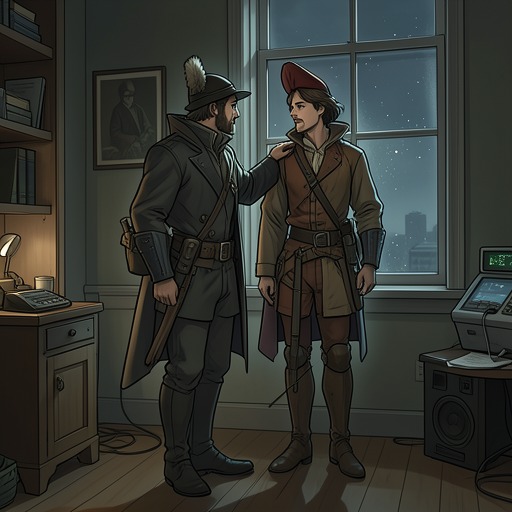
Lennie and Toby’s first kiss
The Sky Is EverywhereLennie and Toby’s first kiss takes place in the immediate aftermath of Bailey’s death, in the bedroom that still belongs to her. It begins in shared mourning rather than courtship: Lennie and Toby speak of surviving each day without Bailey, then comfort each other until consolation becomes a kiss. Lennie does not pull away. For her, the kiss seems momentarily to bridge the loss; its very closeness, however, makes it difficult to separate love for Bailey from desire for the person who was going to marry her.
Causes and Background
The scene follows a conversation about Bailey’s future. Bailey had dreamed of attending Juilliard, and Lennie had assumed she would apply again after enrolling at Clover State. The sisters no longer discuss that abandoned ambition. The silence around it sits beside another future that has been cut short: Bailey and Toby were getting married. Lennie understands that fact as she sits with Toby, whose place in the family’s grief is also that of the person who expected to build a life with Bailey.
The setting makes the loss intimate and difficult to evade. The wind rattles the house; Lennie pulls a blanket over her legs and describes an impulse to cover the orange walls with images of endings. She feels as if she wants to disappear. Instead, she rests her head on Toby’s shoulder and names them both as extraordinarily sad. Their conversation turns from the enormity of grief to the practical impossibility of living through day after day without Bailey. Toby smooths the hair around Lennie’s face, and the gesture becomes the immediate cause of the kiss.
What Happens
Toby keeps his hand near Lennie’s face and does not turn away. As they look at each other, Lennie recognizes that he misses Bailey as much as she does. Toby kisses her; she wishes she could say she pulled away, but she does not. She kisses him back and does not want the moment to end. The physical event is brief, but Lennie experiences it as an imagined reach across time, as if the two of them together could somehow draw Bailey back.
Toby breaks away and springs to his feet, pacing in immediate panic and saying that he does not understand what has happened. He says he should leave, but stays. Sitting on Bailey’s bed, he calls Lennie over and takes her hand. Lennie describes crossing the room with shame and guilt already present, even as she also wants to be near him. The kiss has not resolved what they feel; the two responses coexist in the same movement toward one another.
Toby tells Lennie that being near her is the only time he does not feel as though he is dying from missing Bailey. Lennie says she feels the same. They both begin to cry, sit beside each other, and lie down together on Bailey’s bed, spooning. Lennie falls asleep in Toby’s arms and hopes they are not replacing their own scents with the last traces of Bailey still in the bedding. That thought gives the intimacy its particular unease: Bailey is not merely the reason they are together, but an absence still materially present between them.
When Lennie wakes, she and Toby are facing each other, their bodies pressed together and their breath mingling. Toby looks at her and calls her beautiful. The scene’s emotional movement therefore does not end with the abrupt interruption of the kiss. It continues into a shared night and a more exposed tenderness, while the room and bed keep the dead sister at the center of their closeness.
Immediate Consequences
For Lennie, the kiss becomes a source of conflict as well as comfort. Its temporary sense of reaching Bailey does not make the act feel permissible; rather, that imagined connection reveals how closely her longing for her sister has become bound up with her longing for Toby. Toby’s panic likewise shows that neither of them treats the kiss as an uncomplicated new romance. He tries to leave, admits confusion, and then remains because being near Lennie eases the force of missing Bailey.
The episode belongs to a larger pattern in Lennie’s response to bereavement: intense physical and emotional impulses arrive before she knows how to interpret them. Later, she asks herself what kind of person wants to kiss boys at a funeral and makes out with her sister’s boyfriend. She contrasts this new intensity with her earlier lack of interest in sex and recognizes Toby as the person she has promised Bailey she will never kiss again. The first kiss thus becomes a boundary-crossing event whose significance grows through Lennie’s repeated attempts to judge, deny, or contain what happened.
Significance
The kiss turns shared grief into physical intimacy without displacing Bailey from the scene. Lennie’s image of reaching across time makes plain that she experiences the moment through her sister’s absence, while her fear of replacing Bailey’s scent acknowledges the danger of mistaking closeness to Toby for a way to recover what has been lost. Their comfort is real, but so are the guilt and the unresolved promise attached to it.
The event also complicates the distinction between mourning Bailey and seeking relief from mourning. Toby’s confession that Lennie’s presence briefly interrupts his feeling of dying from loss gives their intimacy an urgent, grief-driven motive; Lennie’s matching response suggests that comfort runs both ways. Yet neither can restore Bailey, and the kiss’s imagined power to reach her lasts only as an experience of the moment. Its lasting narrative importance lies instead in the contradiction it establishes: Lennie and Toby are drawn together by their love and loss of Bailey, while that same bond makes their attraction feel like a betrayal of her.